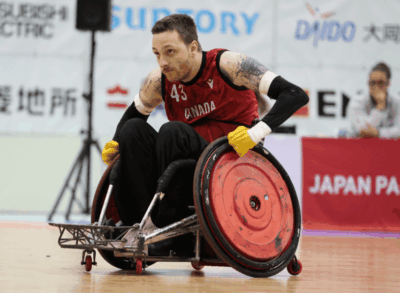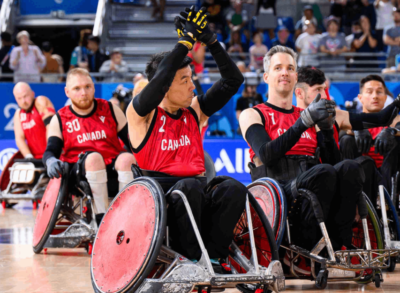
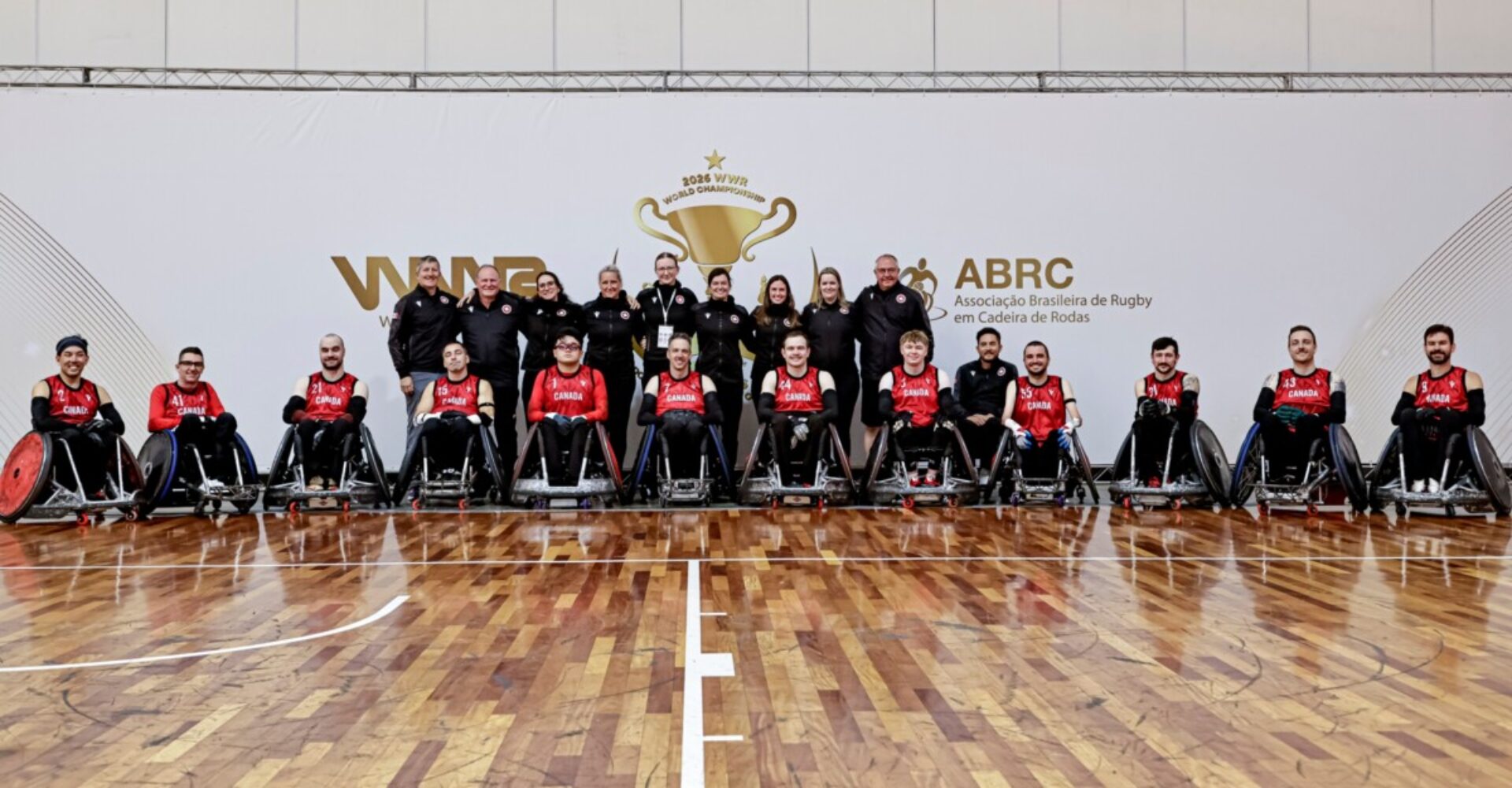
The 2026 Wheelchair Rugby World Championships brought together the world’s best in São Paulo, with Canada represented both on the court and across several key roles throughout the tournament.
Team Canada finished seventh among 12 nations, recording three wins and five losses over eight games. The team faced a challenging preliminary round, competing in a pool that included the eventual gold and silver medalists, Australia and the United States.
The tournament provided valuable experience for a Canadian team continuing to develop toward LA2028. Five athletes made their World Championship debuts in São Paulo: Reese Ketler, Maxime Drolet-Gauthier, Rio Kanda Kovac, Yanick Racicot and Austin MacLellan. It was also the first World Championships as Head Coach for Trevor Hirschfield.
“Looking back at Worlds I am most proud of how this team showed intense determination, toughness, and heart throughout the tournament,” said Hirschfield. “This was some of the best rugby we have played since I came in as Head Coach, sticking to the game plan and playing with excellent chemistry and trust on the court.”
Hirschfield highlighted Canada’s games against Denmark, Great Britain and Brazil as examples of the group’s development throughout the tournament.
“Arguably the underdog in these games, this team showed growth in their ability to play calculated gritty rugby,” he said.
The tournament also included individual award wins by Canadian athletes. Cody Caldwell was named Best in Class in the 2.0 classification and earned Player of the Match honours in Canada’s game against New Zealand. Austin MacLellan led the team in tries scored with 114 tries across eight games, while also earning Player of the Match honours against the Netherlands in the preliminary round. Travis Murao was named Player of the Match in Canada’s final game against the Netherlands.
For Canada’s newest World Championship athletes, the experience provided an important opportunity to compete at the highest level and gain the international experience that will help shape the next stage of their careers.
“Our rookies were able to get that in-game experience needed to build confidence and realize the value of all the consistent training they have put in,” said Hirschfield. “These games provided amazing learning experiences for the team leading into LA2028.”
Canada’s presence at the World Championships extended well beyond the national team roster. Kevin Bowie and Pierre Alexandre Brière represented Canada as referees, with Brière selected to officiate the gold medal game. Chantal St-Pierre served as a Game Commissioner throughout the tournament.
Canada was also represented within the classification team, with Paul Easton serving as Chief Classifier and Julie Bakke as a classifier. Canadian coaching expertise was represented internationally as well, with Dave Willsie serving as Co-Coach of France.
As the Canadian program looks ahead to LA2028, the lessons and experience from São Paulo will be an important part of the journey.
“We have our standard as a program, and the way these athletes continue to be disciplined, persistent, and their willingness to push through the obstacles, creates this excitement looking toward the future,” said Hirschfield.
For Canada, the 2026 World Championships were not simply about the final result. They were an opportunity to test a developing group against the world’s best, give new athletes their first taste of World Championship competition, and continue building the foundation for the next Paralympic cycle.
Related Articles