A Candid Conversation with Mélanie Labelle: Building Space for Women in Sport
On International Women’s Day, we celebrate the women who are not only competing at the highest level, but also shaping the future of sport for those who will follow. Mélanie Labelle is one of those leaders.
On International Women’s Day, we celebrate the women who are not only competing at the highest level, but also shaping the future of sport for those who will follow.
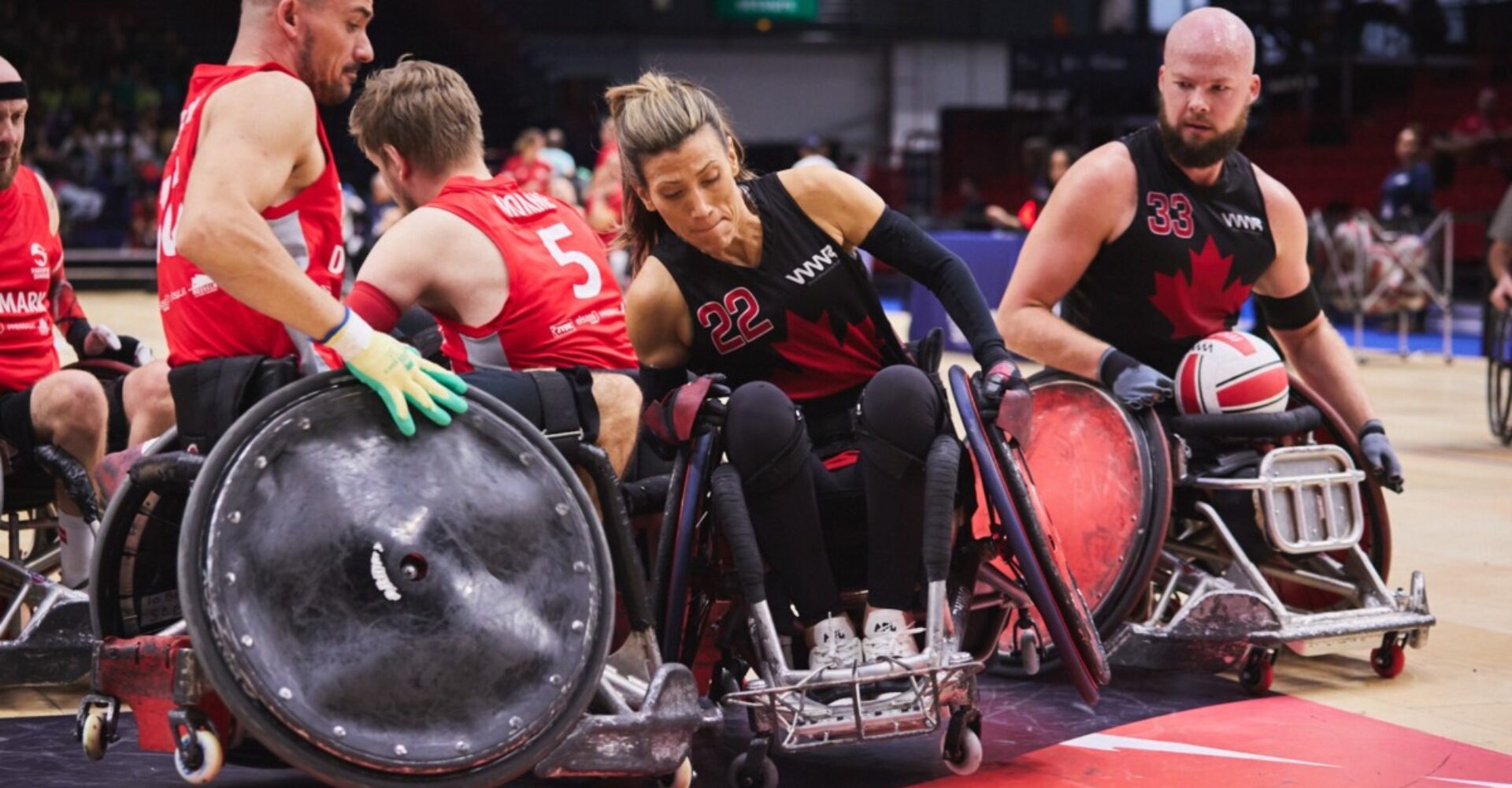
Mélanie Labelle is one of those leaders. A member of Canada’s National Wheelchair Rugby Team, Labelle has spent her career breaking barriers in a traditionally male-dominated, co-ed sport while using her platform to advocate for greater equity, access, and opportunity for women. From her journey into the sport, to her leadership within the Northern Lights Women’s Development Program, Labelle continues to push the game forward both on and off the court.
In this Q&A, Labelle reflects on the biggest barrier to getting involved in wheelchair rugby, the impact women’s professional leagues have had on amateur sport, and why creating intentional spaces for women is essential to building a more inclusive future.
Q: What was the biggest barrier involved in getting into wheelchair rugby?
A: For me, the biggest barrier is the funding aspect. Pre-pandemic, there was more infrastructure. That fell apart during the pandemic, and we’re still rebuilding today. The pandemic was a massive hit in terms of simply having opportunities to play.
Then there are wheelchair rugby chairs. To get my first chair, I combined a couple of grants. I got my chair one-year post-injury. Athletes with paralysis might lose muscle mass over time. The next year, I lost all my leg muscle mass and no longer fit in my chair. I played in that super-wide chair for a couple of years until I could afford the next one. I accumulated more grants, Parasport Québec repurchased my old chair, and I had a total of $12,000. My new chair was $16,000, so I still had to spend almost $4,000 out of pocket.
I’m still in the same chair now, but every year you have to buy new rims, wheels, tubes, glue, gloves.
Q: How has being involved in wheelchair rugby shaped you personally, both as an athlete and off the court?
A: Wheelchair rugby has helped me become a complete person. When I entered the sport, playing was beneficial in my quest for independence, learning about my disability, and becoming a person post-injury. But once you pass that phase, then what? Who are you, and what’s left?
My social life was a little bit lacking because wheelchair rugby takes a lot of time. I started asking myself, what is my contribution to the world? That’s where I decided to use the environment to build more human skills. A huge part of that has been trying to create opportunities for the women’s program.
I’ve also had the chance to represent my teammates as an athlete representative and to be on the Athletes’ Council. Meeting other athlete reps across Canada with diverse skills and jobs has been enlightening. I get perspectives that take me out of my daily life. I also get to meet people on the board of Wheelchair Rugby Canada. I’m involved across the sport.
A couple of years ago, I would have said I wanted to leave the jersey in a better place. I still do, but I also think it’s a bit selfish in a good way. I want to get more out of the sport — to become a complete person while I’m an athlete, so that if I leave this sport, I have something to fall back on. My latest journey is starting to coach.
Q: What is the biggest misconception people have about women in wheelchair rugby?
A: A lot of people associate wheelchair rugby with the risk of injury because it’s a contact sport. Most people ask, “Aren’t you afraid of being injured?” I kind of laugh internally at that, because my daily life is actually a thousand times more injury-prone than wheelchair rugby.
If anything, staying in shape for the sport enables me to be more independent. For me, it’s non-negotiable. I will train every day. Why not have fun?
Q: At what point did you realize that a women’s development program was necessary?
A: Most people who met me through high school sports wouldn’t be surprised by this. When we were in high school, there was no indoor soccer program, so we built it. There was no basketball for women, so we made a team. Every time an activity didn’t exist for us, we created it. No questions asked.
Fast forward to my soccer career. We had a university program, but across Canada, women’s development was very unequal. When I entered the sport, I had opportunities to play everywhere. At university, we were trying to prepare for the season and invite women’s teams from Europe to train and compete with us, but they didn’t exist. So, we prepared by playing against 14-year-old boys.
I’m the same age as Christine Sinclair. She was on a national program and was also a pioneer for the sport. At the time, she was my all-time hero. Fast forward to 2021 — I remember exactly where I was when the Canadian women’s soccer team won Olympic gold. I started yelling and sobbing. There were so many emotions.
Why did Canada’s women perform so well compared to the men? It’s because our women’s program started so much earlier than most countries.
When conversations started about parity in wheelchair rugby and the possibility of the sport becoming more equitable for men and women — as one of the last standing co-ed sports — I thought, why not start now? What are we waiting for? If separation into men’s and women’s divisions is even on the table, let’s start now. And if it doesn’t happen, at least we gave women an experience to be leaders, a space to learn and develop, and a positive environment.
Q: Why is it important to create intentional spaces for women within wheelchair rugby?
A: I can only speak from the perspective of a quadriplegic, and it’s about lived experience. Going through rehab, I never saw another woman with my disability. Where do you ask those questions? There are so many aspects of women’s health. Everyone has isolated experiences, but when you put us in a room together, you realize how many similarities there are. It’s validating.
On a co-ed team, I’m often the only woman — the one-off. But on a women’s team, everyone shares similar experiences. We can exchange tricks and tips.
Some of us also compete in multi-sport. Some are involved in athletics, cycling, or other sports, and we become a crowd of cheerleaders for each other’s successes. That’s really special. Seeing wheelchair rugby women cheering each other on — like watching Julia Hanes compete in India at the World Para Athletics Championships — and having people across Canada on the same chat, watching together and cheering for her success.
Q: Do you have any sport leaders, programs, or organizations that you and the Northern Lights look up to as you build this movement?
A: Coming out of the pandemic before the Tokyo Paralympic Games, we were training at the same time as many of the Montreal-based para ice hockey players. We shared the gym with them for a season. Most of them grew up playing with men because women’s leagues didn’t exist yet, so there was a nonverbal respect between us. We didn’t need to talk about it. We just knew we had similar experiences, and there was a shared bond.
Over the past five years, I’ve also witnessed the creation of the PWHL. When I saw that and the impact it had, it shook the world. At the same time, the women’s basketball league, the Northern Super League — all of these professional leagues are exploding.
I play amateur sport, but the ripple effect these leagues have on our world is massive. I don’t think they even fully see it yet. They’re opening doors. They make it easier for us to bring conversations to the table with stakeholders and be heard. We can only do what we’re doing today because of the work they’ve done.